The Buddenbrooks
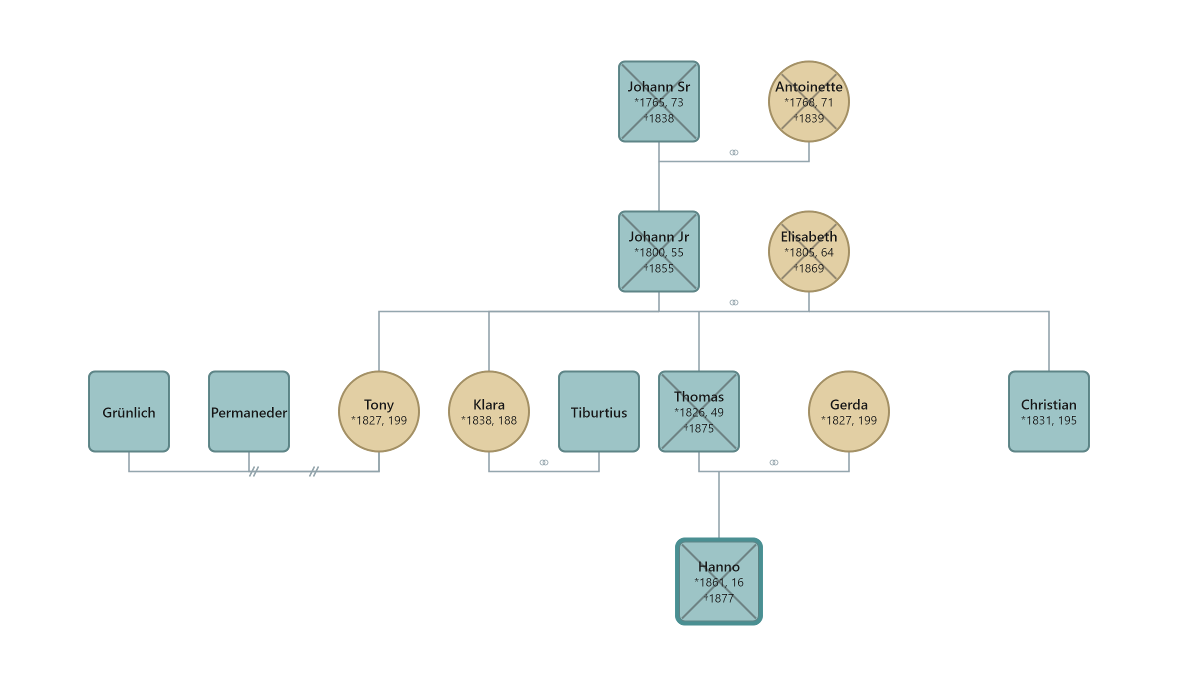
Buddenbrooks: The Decline of a Family (Buddenbrooks: Verfall einer Familie) is a novel by Thomas Mann, first published in 1901. It traces the story of the Buddenbrook family, a prosperous merchant dynasty in Lübeck, Germany, across four generations — from the confident founding patriarch Johann Buddenbrook Sr. to the fragile, artistically gifted Hanno, who dies of typhoid fever as a boy.
The novel won Thomas Mann the Nobel Prize in Literature in 1929. It remains one of the most important works in German literary history and a widely studied example of intergenerational decline in fiction.
Family Overview
The genogram covers the four main generations of the Buddenbrook family:
- Generation I: Johann Buddenbrook Sr. and his wife — the founding couple who establish the family firm in Lübeck.
- Generation II: Consul Johann Buddenbrook Jr. and his wife Elisabeth (née Kröger) — the family reaches its peak commercial and social standing.
- Generation III: Tony (twice divorced — first from the fraudster Grünlich, then from the idle Permaneder), Klara (married to Pastor Tiburtius; dies of tuberculosis without children), Thomas (the dutiful heir; marries Gerda Arnoldsen, a violin virtuoso from Amsterdam), and Christian (the dissolute brother) — the generation in which the decline begins.
- Generation IV: Hanno Buddenbrook — the sole heir, musically gifted and constitutionally fragile, who represents the final generation of the family.
advertisement
Patterns Visible in the Genogram
The Buddenbrooks genogram is an excellent teaching example because the patterns Mann describes in prose are immediately visible in diagram form:
- Progressive weakening of the male line: Each generation of male heirs is constitutionally and commercially weaker than the previous one — from the robust founding patriarch to the sickly Hanno.
- Artistic sensitivity as a counter-value to commercial drive: The emergence of musical talent (Gerda, Hanno) coincides with the retreat from business success.
- Divorce and social failure on the female side: Tony's two failed marriages — to the fraudster Grünlich and the idle Permaneder — and her return to the family home each time illustrate how the female branch of the family is also caught in a pattern of decline.
- Early death: A striking number of family members die young or in middle age across generations II–IV.
Using a fictional family with a well-known source text makes the Buddenbrooks sample particularly useful for teaching genogram notation in educational settings: students can verify the family structure against the novel and discuss how well the diagram captures what Mann describes in words.
Sources
- Mann, T. (1901). Buddenbrooks: Verfall einer Familie. S. Fischer Verlag. English translation: Mann, T. (1994). Buddenbrooks: The Decline of a Family (J. E. Woods, Trans.). Vintage.
- Buddenbrooks — Wikipedia